

Hey there! As a fibreglass grating supplier, I've gotten a ton of questions about how our products hold up in alkaline environments. Alkaline conditions can be pretty tough on materials, and it's crucial to know if your grating can stand up to the challenge. So, let's dive into how fibreglass grating performs in these situations.
First off, what exactly is an alkaline environment? Alkaline substances have a pH level above 7, and they're found in a bunch of industrial settings. Think chemical plants, wastewater treatment facilities, and even some food processing plants. These places use alkaline chemicals for cleaning, processing, or other operations. And if you're using grating in these areas, it needs to be able to resist the corrosive effects of these alkaline solutions.

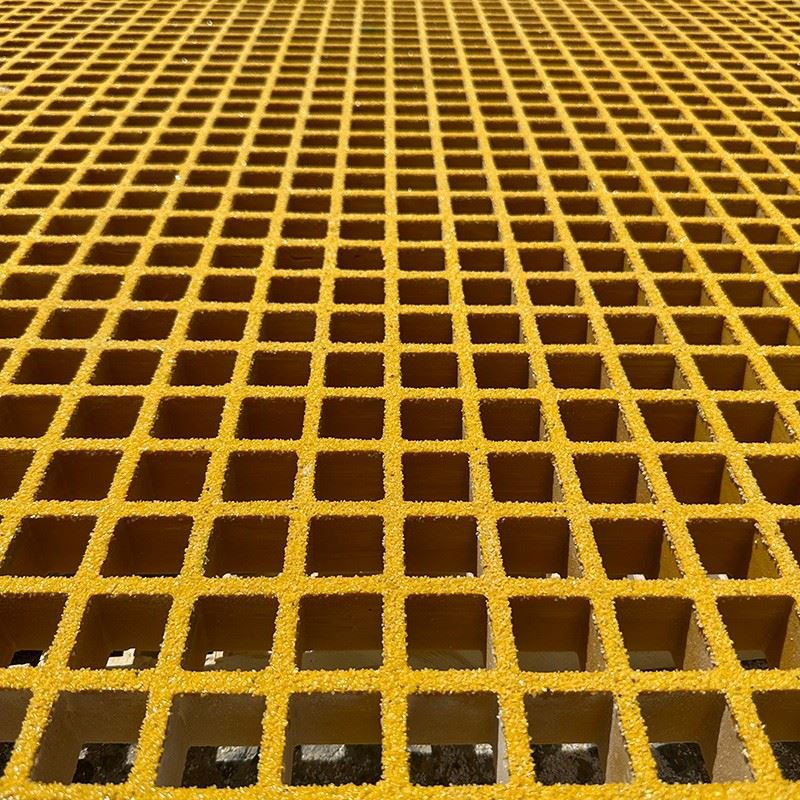
One of the great things about fibreglass grating is its inherent corrosion resistance. Unlike metal gratings, which can rust and degrade when exposed to alkaline substances, fibreglass is made from a combination of glass fibres and a resin matrix. This composition gives it a natural resistance to many chemicals, including alkalis.
The glass fibres in fibreglass grating are the backbone of its strength. They're incredibly strong and provide the structural integrity needed to support heavy loads. And the resin matrix acts as a protective barrier, shielding the glass fibres from the corrosive effects of alkaline solutions. Different types of resins are used in fibreglass grating production, and some are better suited for alkaline environments than others. For instance, vinyl ester resins are known for their excellent chemical resistance, making them a popular choice for applications where the grating will be exposed to alkalis.
Let's talk about some real - world scenarios. In a chemical plant that produces alkaline cleaning agents, the floors and walkways are constantly in contact with these chemicals. If you were to use a metal grating, it would start to corrode pretty quickly. Holes could form, and the structural integrity of the grating would be compromised, posing a safety risk to workers. But with fibreglass grating, it can withstand the continuous exposure to the alkaline solutions. It won't rust, and its strength will remain intact over time.
In wastewater treatment plants, the water often has an alkaline pH due to the treatment processes. Fibreglass grating is a great choice for these facilities because it can handle the wet and alkaline conditions. It doesn't absorb water like some other materials, which means it won't swell or degrade. This makes it ideal for use in areas like pump rooms, clarifiers, and walkways around treatment tanks.
Another advantage of fibreglass grating in alkaline environments is its low maintenance. Since it doesn't corrode, you don't have to worry about painting or coating it regularly to prevent rust. You can simply clean it with a mild detergent and water when it gets dirty. This saves both time and money in the long run.
Now, let's look at some of our specific products. We offer Pultruded Grating, which is made through a pultrusion process. This process creates a grating with a high strength - to - weight ratio and excellent corrosion resistance. The continuous glass fibres in pultruded grating provide superior load - bearing capabilities, and the resin matrix protects it from alkaline chemicals.
Our Fiberglass Grating Sheets are another great option. They come in various sizes and thicknesses, so you can choose the one that best suits your application. These sheets are easy to install and can be cut to fit your specific needs. Whether you're covering a small area or a large industrial floor, our fiberglass grating sheets are up to the task.
Of course, our Fibreglass Grating in general is designed to perform well in a wide range of environments, including alkaline ones. We've tested our products in harsh conditions to ensure they meet the highest standards of quality and durability.
But it's important to note that while fibreglass grating is very resistant to alkalis, extreme conditions can still have an impact. For example, if the alkaline solution is very concentrated or at a high temperature, it might cause some minor surface changes over a long period. However, these changes usually don't affect the overall performance or structural integrity of the grating.
If you're working in an alkaline environment and need reliable grating, we've got you covered. Our team of experts can help you choose the right type of fibreglass grating for your specific needs. We understand the challenges you face in these industrial settings, and we're committed to providing you with the best products.
Whether you're a new customer looking for a durable solution or an existing customer in need of a replacement, we're here to assist. Contact us to discuss your requirements and get a quote. We're confident that our fibreglass grating will meet your expectations and provide long - lasting performance in your alkaline environment.
Let's work together to find the perfect grating solution for your project!
References
- Corrosion Resistant Polymer Materials: Principles and Applications. Some book by an author.
- Industrial Grating Handbook: Performance and Selection. Some other publication by relevant industry experts.